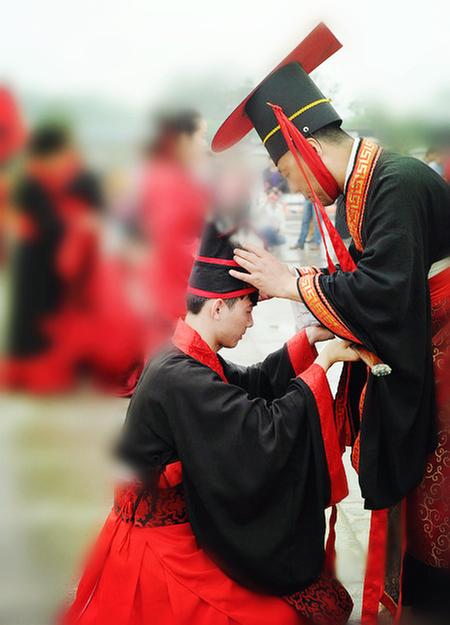
Capping Ceremony
Introduction
The Capping Ceremony, known as "guan li" in ancient China, was a significant rite of passage marking the transition of young males into adulthood. This ceremonial tradition dates back over 2,000 years and was deeply rooted in the cultural practices established during the Zhou Dynasty, as detailed in the "Li Ji" or "The Book of Rites". The ceremony was part of the Confucian rites known as the "four rites", which also included marriage ceremonies, mourning rites, and sacrificial rituals.
In ancient Chinese society, the Capping Ceremony was a pivotal event that signaled a young man's entry into adulthood at the age of 20. This transition allowed him to assume responsibilities within the family unit and granted him the societal right to marry. The ceremony was an elaborate affair compared to the simpler hair-pinning ceremonies held for females, reflecting the societal roles and expectations placed upon men. For women, adulthood was marked at the age of 15 through the hair-pinning ceremony, known as "ji li".
Ceremony Components
The Capping Ceremony was a complex process, filled with symbolic gestures and rituals. It began with the selection of a fortunate day for the ceremony, during which the boy's family invited numerous guests to witness the event. The ceremony was led by a master of ceremonies, who was assisted by the boy's parents and an assistant. Prior to the rite, the boy underwent preparatory steps, including bathing and hair grooming, before retreating to a designated room.
The ceremony commenced with a speech by the boy's father, followed by the boy's presentation to the assembled guests. The master of ceremonies then performed a ritual handwashing before placing a "fu tou", a traditional head cap, onto the boy's head. This was followed by a costume change to match the head cap, signifying the boy's first step into adulthood. The boy would then return and be given a hat, necessitating another costume change into a dark-colored outfit appropriate for adult men. Upon completion of the ceremony, the boy would salute the guests, formally recognizing his new status as a "man".








